Ring Holders
Valentine's Day Ring Holder Displays: Styling Tips for Independent Jewellers
Valentine's Day gives independent jewellers something the multiples rarely manage well: a reason to build a small, deliberate display that people actually stop and look at. Ring holders are the natural hero, because they carry the most emotionally loaded item in the shop and they photograph beautifully. Below are styling ideas you can scale to whatever space you have, from a full window to one shelf beside the till.
Start with a Palette, Not a Prop
Resist the urge to buy a bag of red hearts and scatter them. Two or three colours will do more work than ten props, and the rings need to be the brightest thing in the frame. Everything else is background.
Pick a base colour, a metal and one accent. Bases that flatter most stock: burgundy velvet, deep aubergine, blush pink, soft cream, charcoal grey. Metals: antique gold, brushed brass, polished silver. Accents: a single red rose in a narrow vase, a length of narrow satin ribbon, a plain cream envelope.
Test the fabric under your own lighting before you commit. Warm bulbs push burgundy towards orange and can make pale pink look grey; cool white LEDs drain reds and turn silver slightly blue. Take a swatch to the counter, rest a ring on it, and look at it from the spot where a customer will stand.
Three palettes that work with most stock
- Burgundy velvet holder, brass tray, cream ribbon. Warm and traditional. Good with yellow gold and amber or ruby-toned stones.
- Blush pink suede, polished silver, one white flower. Soft and modern. Good with platinum, white gold and diamonds.
- Charcoal base, one deep red accent, plain card tags. Graphic and restrained. Suits a minimal shop interior and darker cabinets.
If your stock is a mix of metals, choose the palette that matches what you sell most of, and move the rest into a different part of the case for the fortnight. A display that fights itself is worse than no display.
Pairing Ring Holders with the Rest of the Display
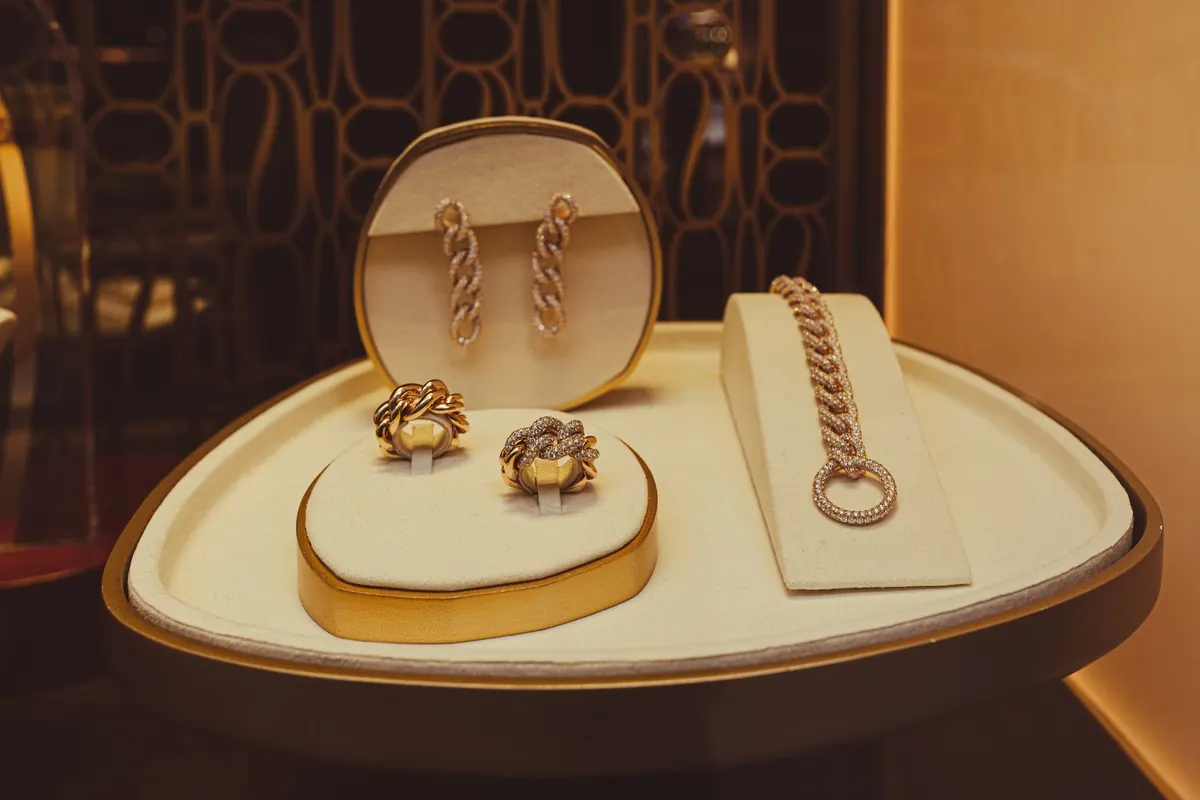
A lone ring holder in an empty window looks like a mistake. Build around it, but keep the count low. Odd numbers, varied heights, one clear point of focus.
The three-piece trio
- Place the tallest item at the back, off to one side rather than dead centre: a slim necklace bust, a tall ring cone, a stacked pair of boxes.
- Set the ring holder in the middle and slightly forward, at a height where the ring sits level with the customer's eye.
- Finish with something low and wide at the front: a ring dish, a folded square of velvet, a small tray holding two or three loose bands.
Vary heights by roughly five to ten centimetres. If everything sits at the same level, the eye slides straight over the whole arrangement. Pairing ideas that read quickly: a ring holder beside a single-stem bud vase; a holder beside a neat stack of two or three ring boxes; a taller plain cone next to a shorter, softer one so the pair suggests two people rather than one.
Layouts Built Around the Gift
Most Valentine's shoppers are buying for someone else, so show them a finished gift rather than a single ring sitting in a case.
The proposal corner
One ring on a raised holder, under your tightest spotlight, on a surface that is otherwise empty. A closed box beside it with the ribbon untied. This works because it removes choice: there is one ring, and the customer's eye has nowhere else to go.
The pair-up shelf
Two holders side by side with visible space between them, one ring on each. It suits couples, promise rings and matching bands, and it gives you a natural place for a handwritten card that reads simply one for each.
The stack builder
Thread three or four stacking rings onto a single holder at different heights, then add a small dish of loose options alongside. This is the layout that earns add-on sales, because it lets a customer picture building a set rather than choosing one piece and stopping.
Stand at the doorway. If your eye lands anywhere other than the ring, take something away.
Windows and Front-of-Shop Tables
Window displays are read at a distance, often from a passing bus, so simplify harder than feels comfortable. One hero ring holder per bay, centred in clear space. Use risers to lift it: a covered book, a plain block, a stack of boxes. Keep the base line clean and limit each bay to three elements.
Angle your lighting so the ring throws a small shadow. It adds depth, which matters more than it used to because customers photograph windows and share the pictures.
For a front-of-shop table, work at chest to eye height rather than down at knee level, and keep a small mirror nearby. A mirror at counter height lets someone try a ring on and see it without leaning awkwardly across the display.
Timing, Lighting and the Details Customers Notice
Put the Valentine's display up in the last days of January or on the first of February. Take it down on the fifteenth, and resist leaving it into March; a tired themed display makes the whole shop look tired.
On lighting, warm bulbs are kinder to reds and pinks. Where you can, choose holders with a matte or fabric surface so metal bases do not throw glare back at the customer. Check the arrangement in the evening light as well as the morning, since shop lighting changes through the day.
- Clean every holder before it goes out. Velvet holds dust and metal bases show every fingerprint.
- Wear cotton gloves when placing stock. Marks on polished silver read as scratches in photographs.
- Keep prices discreet: handwritten on the back of a card, so the ring stays the focus.
- Refresh real flowers every other day. A wilting rose undoes the rest of the work.
- Secure high-value pieces and follow your insurer's guidance on overnight window displays. If in doubt, set the display out each morning and bring the stock in at close.
A Setup Checklist for the Day Before
Choose the palette and lay out the fabric, the holders and the risers on a clean counter first, away from the case. Place the hero ring holder, then add no more than two supporting pieces. Check that the metal of the holder suits the metal of the rings, unless the contrast is clearly deliberate. Photograph the finished display on your phone: if it reads well on a small screen, it will read well in the shop, and it will do a second job on social media.
Then leave it alone. A Valentine's display works best when it looks considered rather than full, and a single ring holder given room to breathe will outsell a crowded shelf every time.
Photo: Darbagan / Pixabay
Related Articles