Showcases
How to Build a Christmas Showcase for Jewellery Sales
December shoppers move quickly and decide quickly. A Christmas showcase has one job: to slow that pace, just for a moment, so that a piece of jewellery reads as the obvious gift. You will not manage that by burying the display in tinsel. It comes from a clear palette, light that flatters metal and stone, and props that suggest a present without competing with it. Get those three things right and the showcase does a good part of the selling before anyone asks for help.
Start with a palette, not a pile of decorations
Choose three colours at most. One base — deep green, midnight blue, charcoal, warm ivory — one metallic, and one festive accent. Combinations that rarely fail: forest green with brass and cream, midnight blue with silver and white, or burgundy with gold and ivory. Write the palette down and hold yourself to it, because the temptation in week three is to add one more thing.
Then check the palette against your stock. Silver and white gold need contrast, so place them against dark green or navy rather than pale grey. Yellow gold lifts beautifully on deep green, burgundy or navy. Rose gold can blur into warm reds and blush pinks, so give it a cool base or a crisp white backdrop. Pearls want something rich behind them; on white they simply vanish.
Carry the same scheme from the window to the counter. A customer who sees green and brass outside, then a mismatched tray inside, senses the change even if they could not explain it. Consistency is what makes a small shop look considered.
Light the jewellery, not the decorations
Festive lighting should support the pieces rather than compete with them. Warm white in the region of 3000K suits gold, pearls and amber-toned stones. Cooler light makes diamonds and silver look sharper and more modern. Where your cabinet allows it, run LED strips under the glass shelves so the light travels up through the pieces instead of bouncing off the top of the glass.
Small spot lamps angled at roughly thirty to forty-five degrees create sparkle in faceted stones. Light from directly above tends to flatten them. Keep fairy lights behind or below your display line, working as a backdrop rather than a foreground, and choose battery sets with a timer so nobody has to remember them at closing time.
Never put a hot bulb close to pearls, amber, resin or waxed cord; heat can dry and damage them over time. Real candles might photograph well, but in a busy shop they are a liability. If you want flicker, use a sealed LED candle tucked well behind the display.
Three lighting checks worth doing
- Stand where the customer stands, about a metre and a half back, at eye level. If a piece disappears from there, it will disappear during the sale as well.
- Look for glare on the glass in daylight and after dark. Angle the lamps down a few degrees or move the piece further back.
- Turn the room lights off and on. If your spotlights are the only thing making a piece look good, adjust now rather than in front of a customer.
Choose props that add warmth without stealing the show
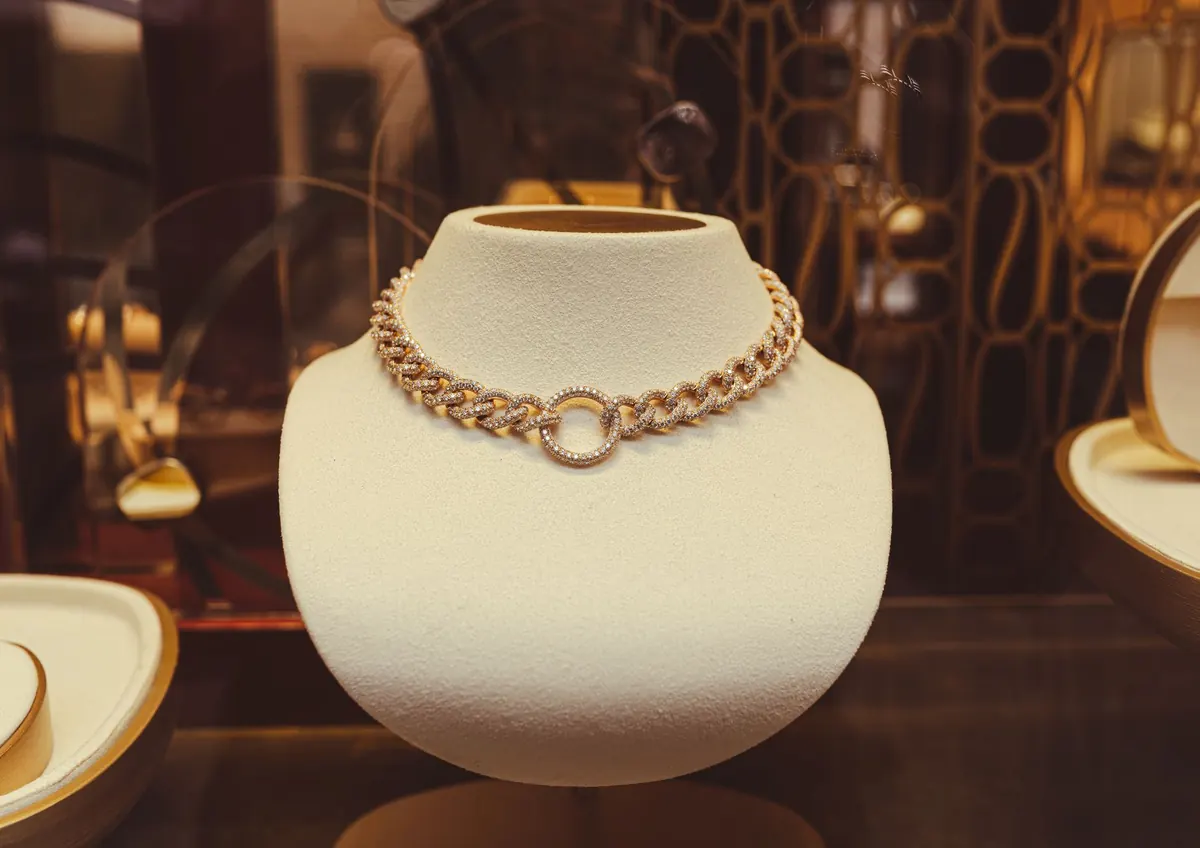
Props are the supporting cast. Good ones include velvet or suede risers in cream, charcoal or deep green, brass and gold trays, small birch logs, dried orange slices, cinnamon sticks, sprigs of evergreen, ribbon spools, wooden stars, and mirrors or glass discs to bounce light around. Miniature wrapped gift boxes in your palette tie the whole scene to the idea of giving.
Leave out the loose glitter that migrates onto every surface, the tinsel strands that catch in settings and clasps, fresh pine that sheds needles and sap, and scented candles or diffusers near the display — strong scent competes with the experience of trying a piece on. Oversized decorations can make a delicate pendant look small, so scale props to the jewellery.
A useful rule of thumb: props should take up no more than about a third of the visual space, and the tallest items belong at the back. If a decoration is the first thing you notice, it has taken a job that belongs to the jewellery.
Build height and a clear route through the display
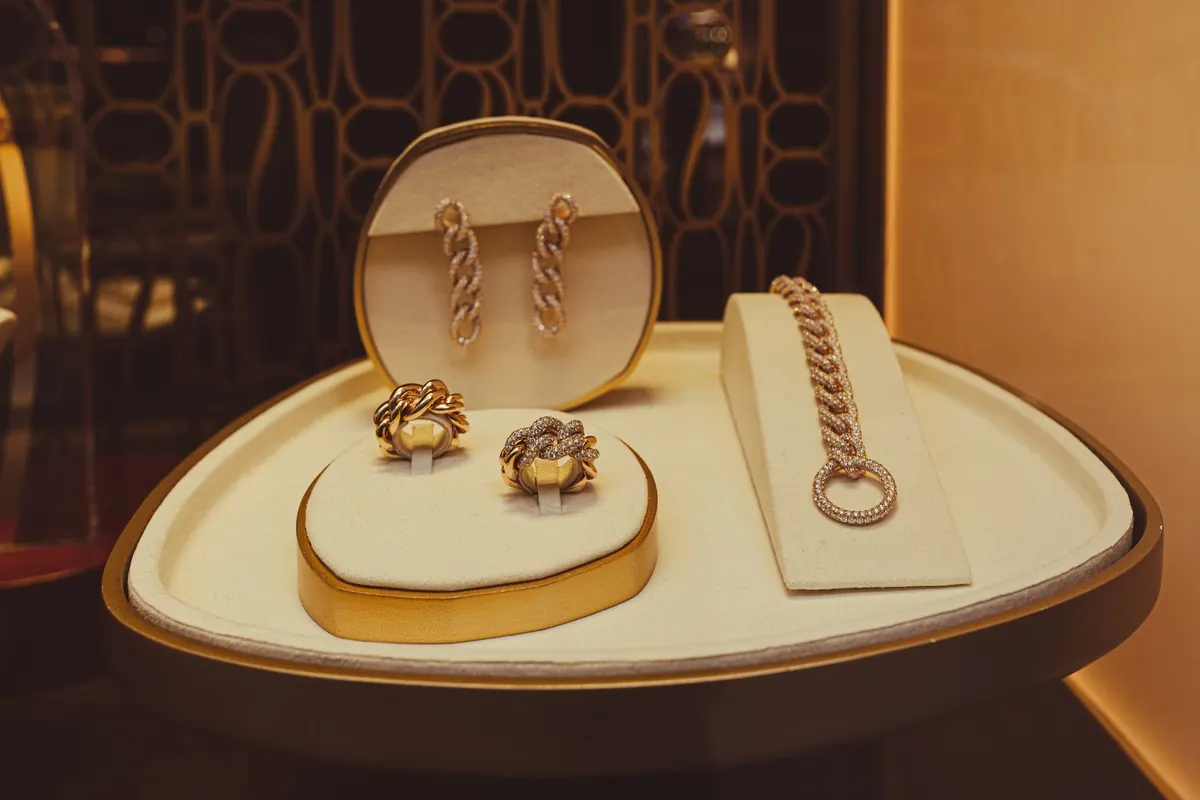
Use a staircase arrangement — highest at the back, stepping down towards the front — or a zigzag that moves the eye left to right. Group in threes: three pieces of different heights but one theme, or one hero piece with two smaller items that echo it. Leave gaps. Space reads as value; crowding reads as a jumble sale, however good the individual pieces are.
Guide the eye towards the piece you most want to sell. That is usually a mid-priced gift rather than the most expensive item in the cabinet, so place it slightly right of centre, where the eye tends to settle.
Present gift-ready sets
Think of each tray as a present waiting to be handed over: a necklace with matching earrings and a wrapped box beside it, or a bracelet with its box, ribbon and a small tag. Empty wrapped boxes in the same paper reinforce the message without cost. A little card listing what is in a set saves questions and encourages the larger purchase.
Only display what you can actually supply. Nothing deflates a sale faster than a customer pointing at a piece you cannot sell, and the same applies to gift boxes — keep enough in stock to wrap everything on show.
Keep it fresh from the first week of December to Christmas Eve
A Christmas showcase ages quickly. Dust shows under warm light, ribbons droop, and the arrangement that looked sharp on the first of the month can feel tired by the fifteenth. Build a short routine: dust and polish the glass before opening, straighten the pieces, remove fingerprints, and check that every item still has its tag.
Change one element every few days — a new ribbon colour, a different riser, a swap of accent pieces — rather than rebuilding the whole display. Replace sold items immediately with something similar so the composition holds its shape. Keep a small box of spare props behind the counter for exactly that purpose.
A set-up routine that fits into an afternoon
- Empty the cabinet and clean it properly, including the glass shelves and the inside of the doors.
- Lay in the base colour with fabric, paper or a mat, and commit to the palette.
- Add risers and build your heights before any jewellery goes in.
- Place the hero piece first, then arrange the rest around it in groups of three.
- Add props last, stepping back after each one to check that it earns its place.
- Set the lighting, then view the whole cabinet from the customer's side of the counter.
- Photograph it on your phone so that re-creating the arrangement after a busy Saturday takes minutes rather than hours.
Do this once and the rest of December becomes maintenance instead of a rebuild. The jewellery stays the star, the festive touches do their quiet work, and a shopper in a hurry still stops for a second look.
Photo: amine photographe / Pexels
Related Articles